
In September 2024, the Group was delighted to exhibit at the Barbican Library in the City of London. Each member had her own interpretation of the theme “London Life” with subjects from Londoners, urban wildlife, the structures, the history and even dreams.
In a vast conurbation, people watching can be fascinating as several members proved.
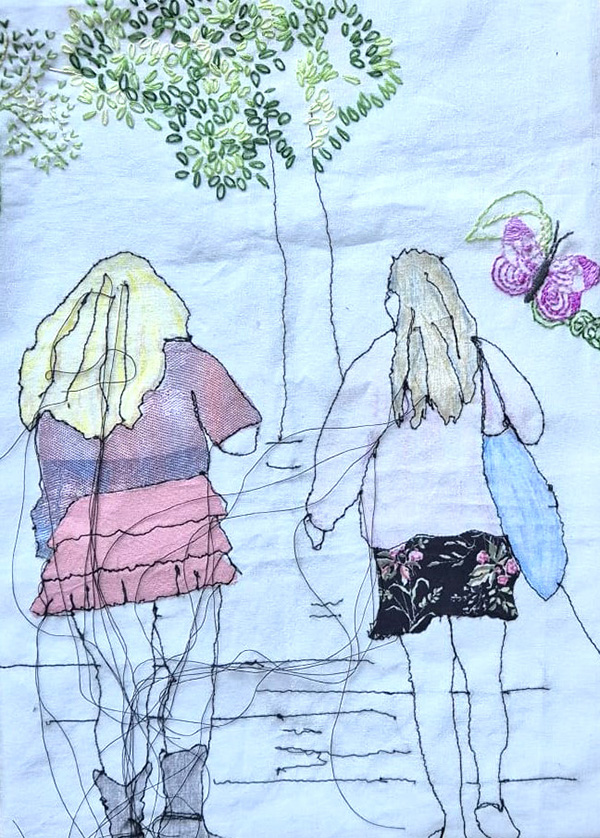
London Sunshine by Patti Taylor
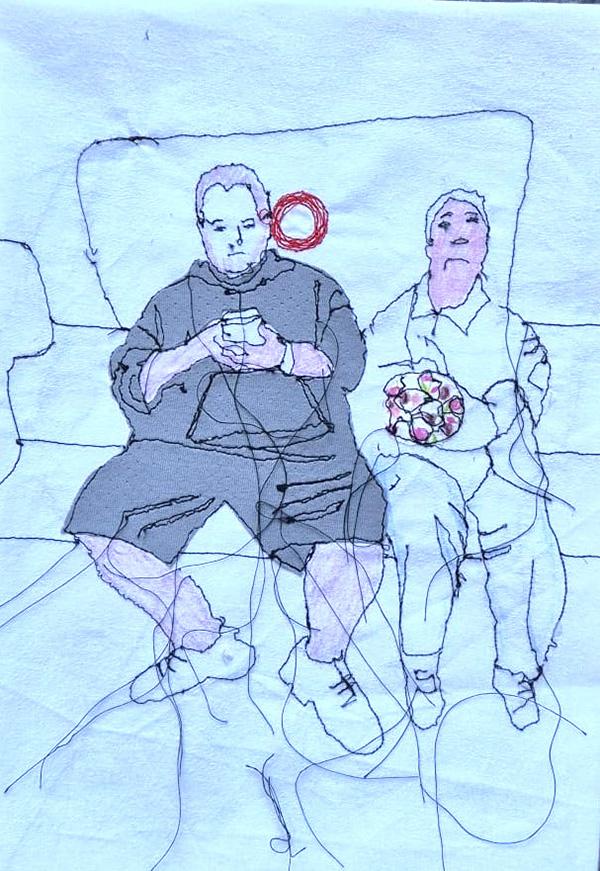
Oh, really by Patti Taylor

Rush Hour by Patti Taylor
Patti Taylor says that for long she has used her own photographs as the basis of her work; these have frequently been of land- or seascapes.
For this show at the Barbican, she captured images of fellow travellers in London streets and on the tube. She used fabric collage to create their clothing and stitch to emphasise their posture. She was delighted when two of the stitchings found new homes.
Needless to say, no permission was asked to photograph her subjects, but rest assured that no pedestrians or passengers were harmed in the creation of these artefacts
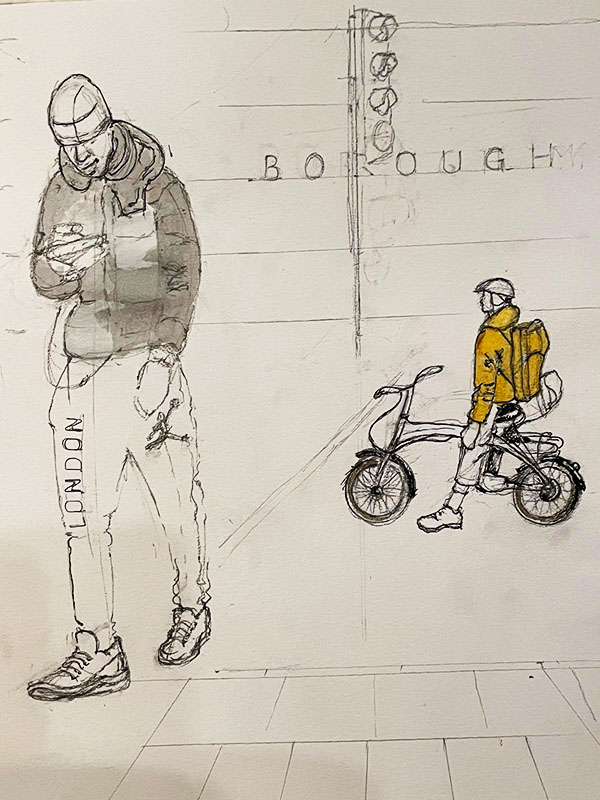 Borough High Street by Joan Glasgow
Joan Glasgow likes to visually analyse the natural way people move, stand or sit, and this study is no exception. The scene was at Borough High Street and she wanted it to be clear that it was in London for people not familiar with the city, so she added the word London to his trousers and removed the Michael Jordan Logo, both of which can be seen in this early version.
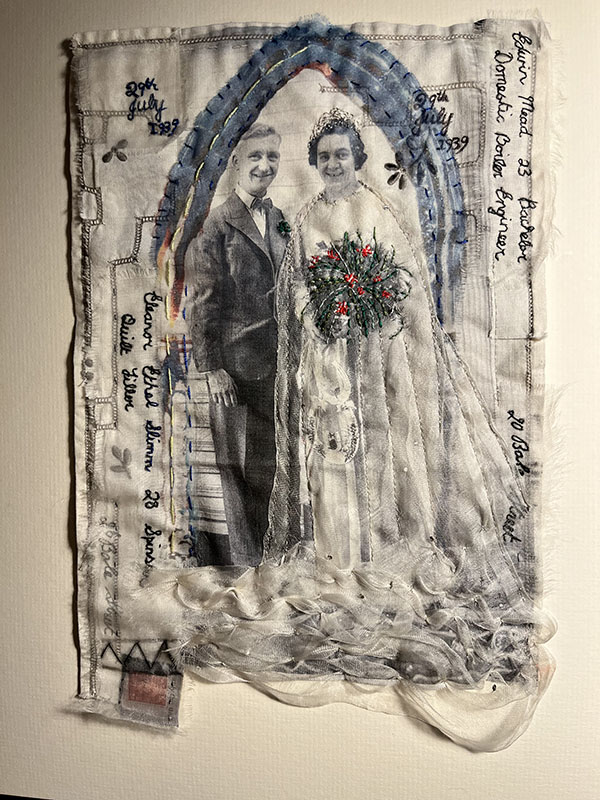
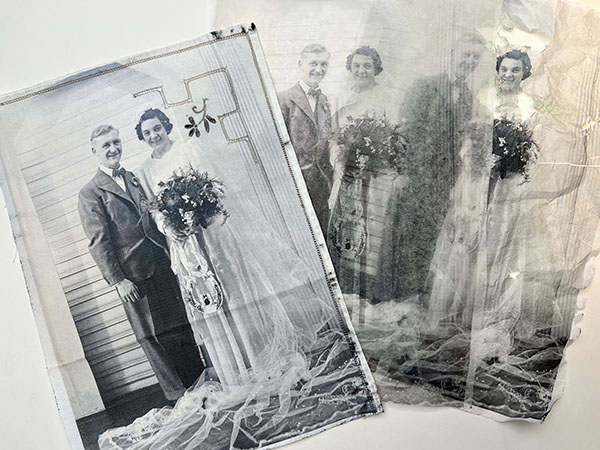 A London Wedding by Linda Walsh
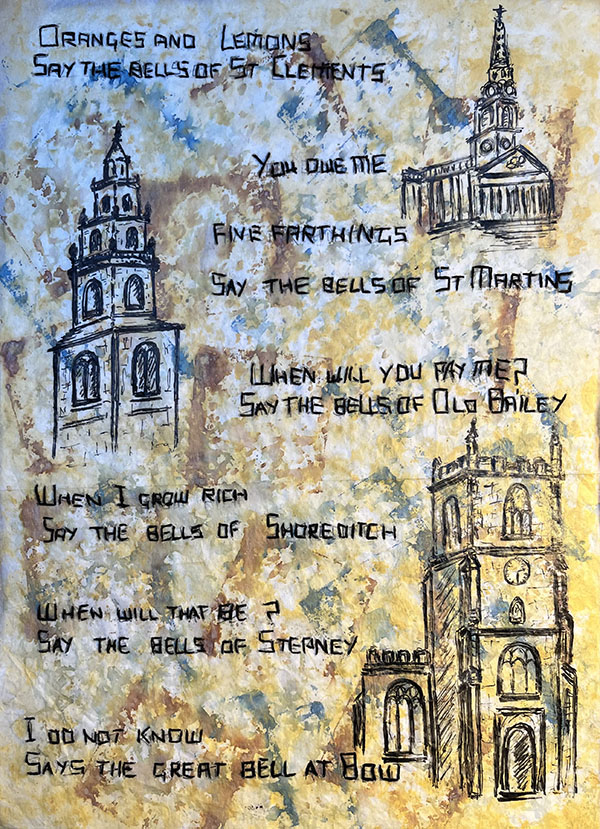 London Churches
Linda Walsh looked to her own family for inspiration. She has lived on the edge of London for most of her adult life as do many relatives. Both her parents were real Londoners, born within the sound of Bow Bells, loving their city. So she searched out their marriage certificate and wedding photograph to use as a base for a piece for the exhibition titled ‘A London Wedding 1939’. She had heard stories about their wedding, at the time they were neighbours in the same street and a barrel of beer on the doorstep was popular with friends and neighbours!
The photo was printed on some vintage table linen and organza added to represent her very full veil and some stitched words copied from the certificate. Linda comments that while she loved the texture from the edges of the organza, her mother would have wanted the edges neatly finished! The other piece honours the church where they were married as it was mentioned in the London rhyme ‘Oranges and Lemons’, with the rhyme stitched and adding pen sketches of some of the church towers.
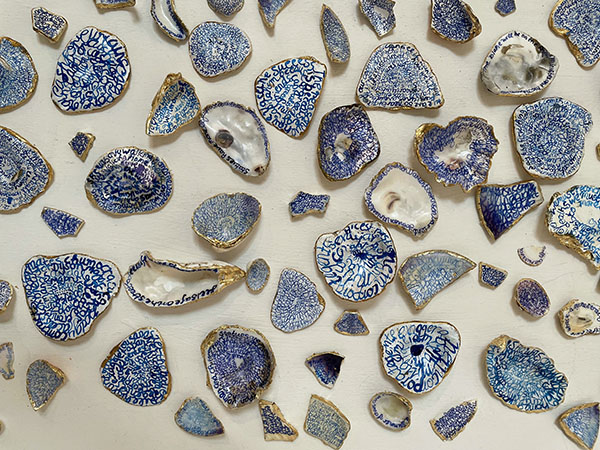 Ostraka by Maria Walker
Maria Walker drew on older history for her inspiration. In her work Ostraka Maria combines the important historical role the humble oyster has played in feeding the growing population with London’s role as the home of the British Parliament.
Ostraka are pieces of pottery with scratched in entries to a vote and the term Ostraka is from the Greek word ‘ostracon’ that literally means oyster shell.
Maria has decorated oyster shells collected from the Thames foreshore with political sound bites from the Government and the opposition party from 2020 and 2021 thus recording them for posterity.
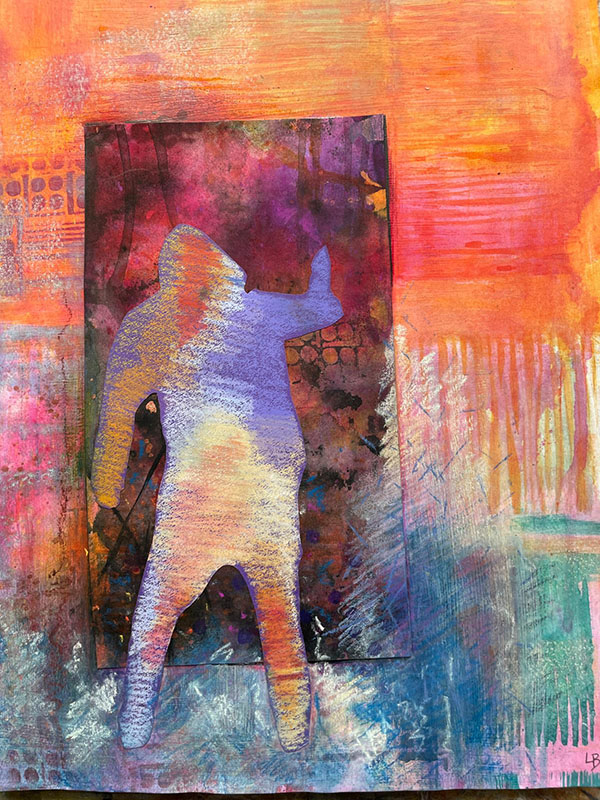 The Portal by Lynne Butt
The Portal is a piece of work by Lynne Butt from a series about a graffiti artist who dreams of finding a portal in the city. It transports him to a time of crusading Knights.
Other members looked to nature that makes London unusually green for a capital city.
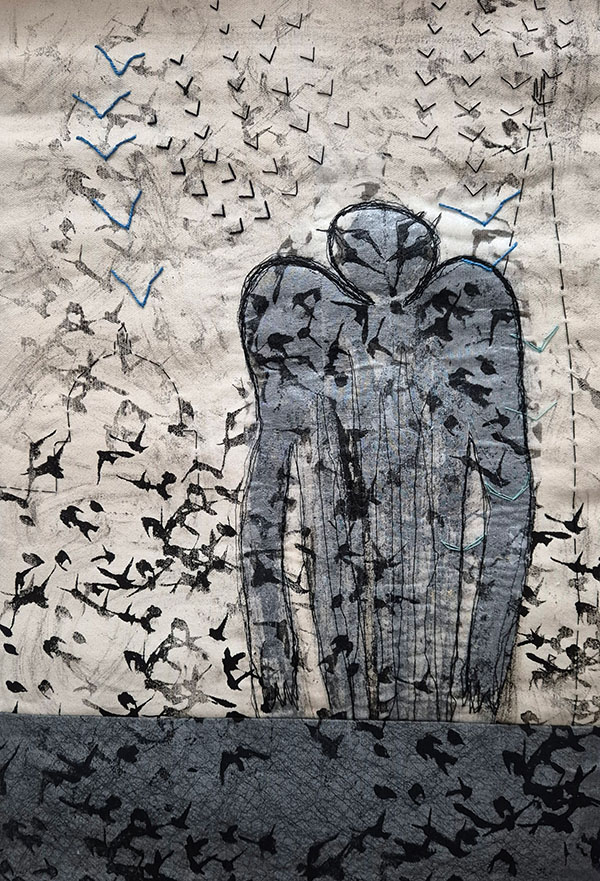 Mutual Threat by Joan Bingley
Joan Bingley’s recent work has considered threats to birds, with those from humans being among the most significant. The main images in this piece come from the images developed of frightened birds and threatening people.
When Joan worked in an office near London Bridge, a winter joy was the sight of huge numbers of starlings dropping into trees between Southwark Cathedral and the river. Against the sunset glow on the dome of St Paul’s across the river, this was an unforgettable sight. So the outlines of cathedral and the Shard provide the contrast between man-made and natural objects.
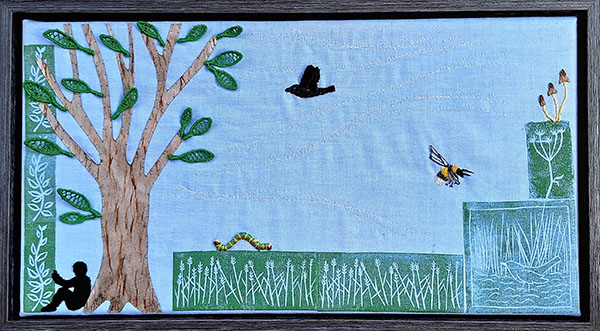 The Lungs of the City by Rosaline Darby
Rosaline Darby noted that looking out across London from any high vantage point, unlike most other cities where the view is mostly of brick and concrete, the dominant impression of London is the green of leaves and trees. From Hampstead Heath and Highgate Woods in the north to Richmond and Bushy Parks in the south, London is blessed with large areas of un-manicured public open space encompassing ancient woodland and magnificent old trees. These, as well as the many more formal parks and squares, and the abundant, mature street trees provide recreational opportunities for London’s residents, keep the air cleaner than it otherwise would be, and make London one of the most liveable cities in the world.
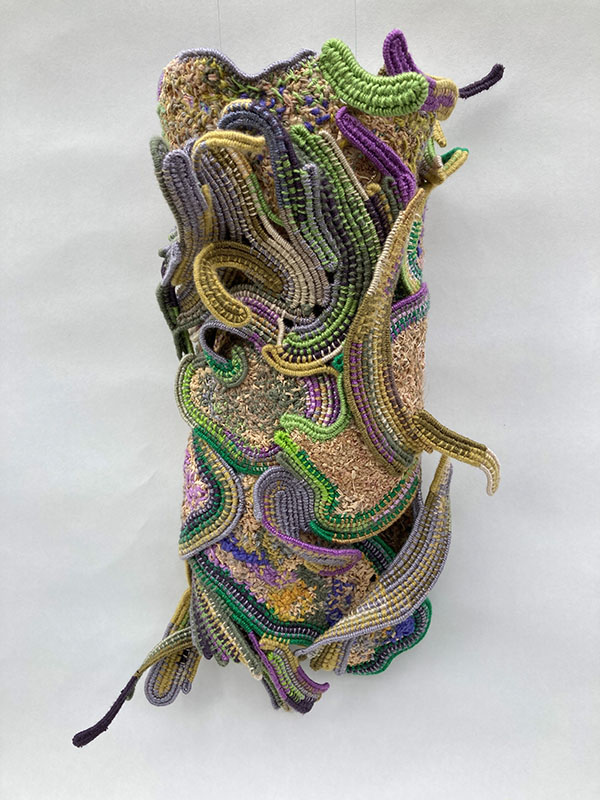 Shedding Bark by Joan West
Plane trees are a common feature of London and so were chosen by Joan West as a good symbol for the London Life exhibition. The basket is a representation of their bark and is made of random weave sections that are joined together with coiling. The individual sections were stitched with seeding stitches using raffia and cotton thread.
Joan wanted to capture the unique peeling nature of the bark, and exaggerated some of the small areas of colour in choosing the colour scheme.
Textures and scenery provided further sources of inspiration.
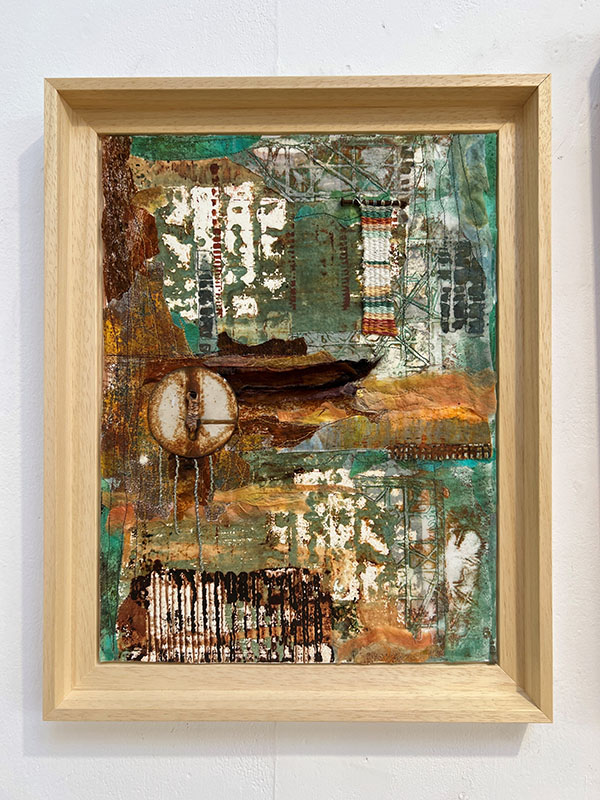 Urban Grime by Jo Coombes
Jo Coombes tried to capture the essence of the stained, eroding walls under the station arches. She used a rusted artefact salvaged from the gutter and reimagined the palimpsest of torn and flaking paper on hoardings and pillars.
A small weaving depicts the matted and built up textures of years of neglect.
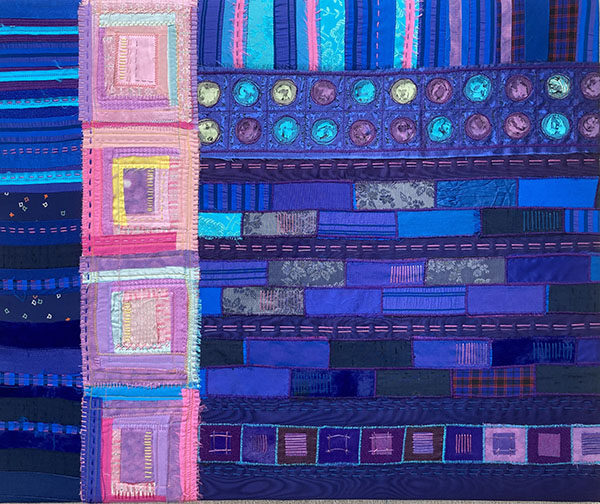 City Lights by Kate Davis
Travelling through the city gave Kate Davies the idea for this piece of work. The colours of the illuminated windows and reflections were enhanced by the wet effect of the rain.
Many different fabrics have been applied to give the impression of patterns made by the building structures and the log cabin technique is used for the windows. A heat tool was used to create the circular shapes reminiscent of traffic lights. Hand and machine stitches increase the texture of the end result.
“Marc Chagall said: “What I mean by “abstract” is something which comes to life spontaneously through a gamut of contrasts, plastic at the same time as psychic, and pervades both the picture and the eye of the spectator with conceptions of new and unfamiliar elements.”
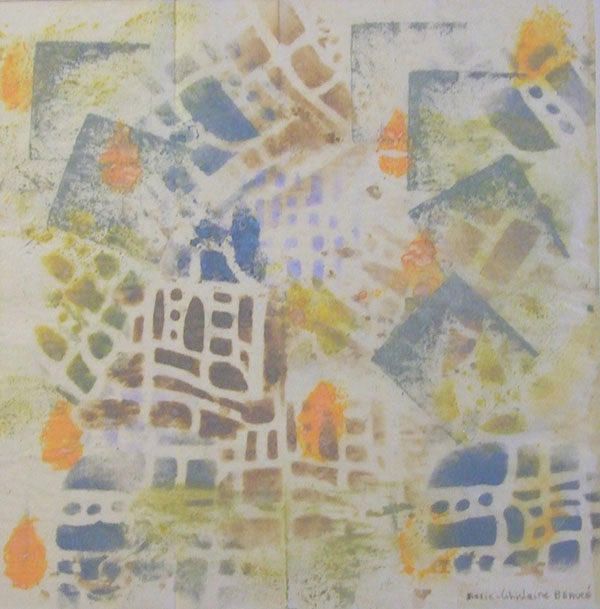 Blue City by Marie-Ghislaine Beaucé
Marie Ghislaine Beauce’s textile creations with minuscule intertwining threads capture the charm found in ordinary overlooked elements of our daily existence. They personify Chagall’s statement in woven tapestries whose textures metamorphose into interwoven works of art. They are composed mainly of soft furnishing fabrics, cotton or linen ribbons, polyester chiffon dress fabrics, dyed cord and bias binding tape.
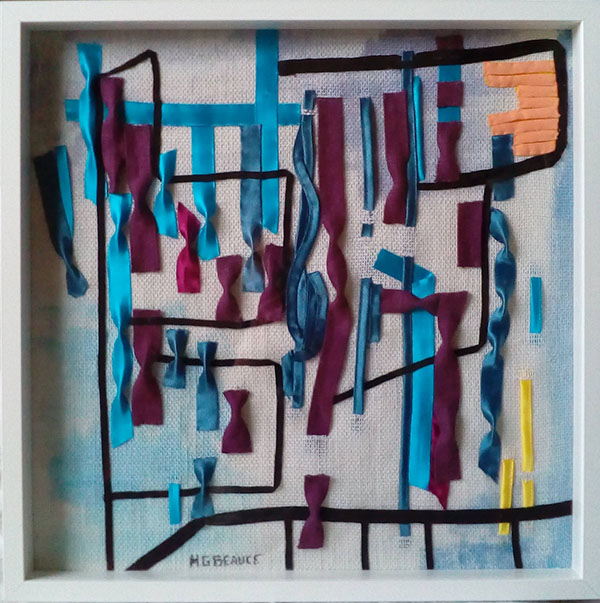 After the Rain by Marie-Ghislaine Beaucé
 A Walk in the Park by Marie-Ghislaine Beaucé
“After the Rain” is an abstract representation of the reflections of coloured lights on the pavement following a good downpour; “A Walk in the Park” is an evocation of the atmospheric hues through greenery pierced by rays of light on a sunny day; “Rhapsody in Black” and “Rhapsody in White” celebrate the vibrant soft furnishing design industry in Great Britain.
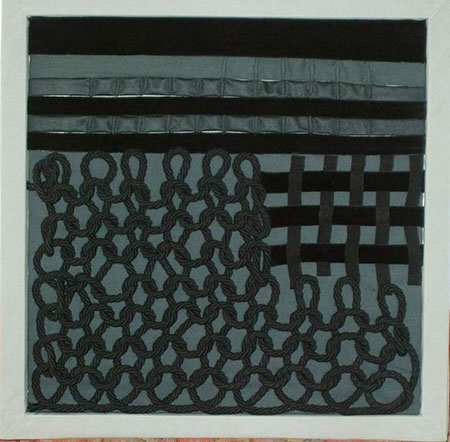
Rhapsody in Black by Marie-Ghislaine Beaucé
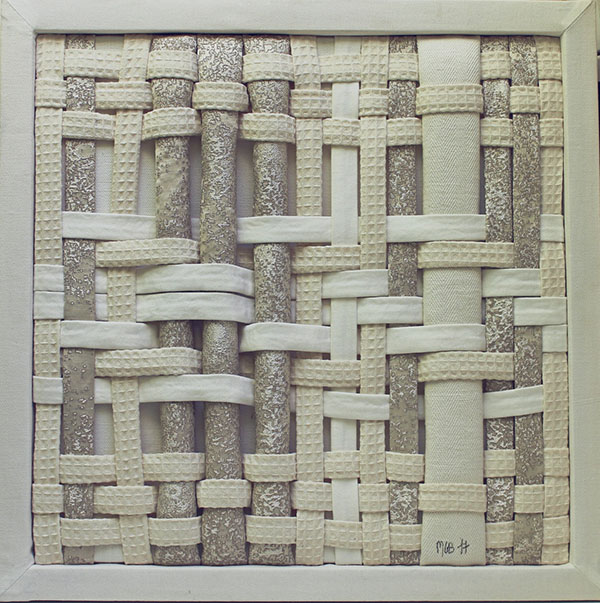
Rhapsody in White by Marie-Ghislaine Beaucé
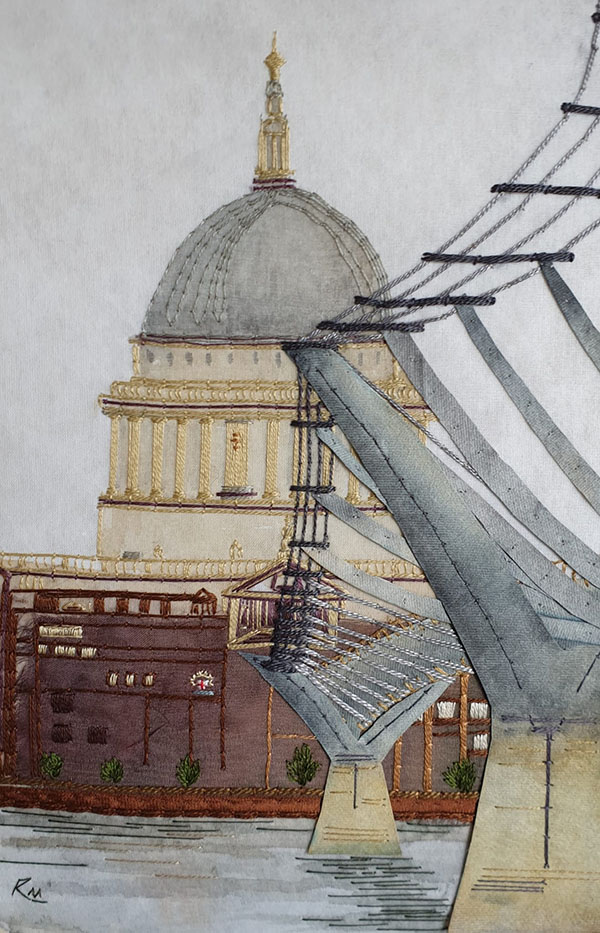 Millennium Bridge by Robertta McPherson
The varied architecture of bridges spanning the River Thames in Central London reflects their age and use. For many years road and rail connections dominated whereas more recent bridges provide additional connection for pedestrians. The Millenium was marked by a new pedestrian bridge between the Tate Modern Gallery on south bank and St Paul’s Cathedral on the north bank. The juxtapostion of the old and new architecture was emphasised by the modern style of the bridge and explored by Robertta McPherson.